


You own land. Maybe it’s an inherited parcel on the edge of town. Maybe it’s a few acres in a rural county that you’ve been meaning to “do something with.” Maybe it’s a stretch of semi-arid land that conventional wisdom says isn’t worth farming. Whatever the case, that land is sitting idle — and idle land is silent money going to waste. It’s time you turned your idle land to income.
Here’s what most landowners don’t realise: you don’t need fertile soil, irrigation infrastructure, or expensive machinery to generate consistent income from your land. You need bees.
At Mister Bee, we’ve built our entire business model around a simple but powerful truth — beekeeping is one of the most capital-efficient, low-disturbance, and scalable agricultural activities available to Kenyan landowners today. This article is our case to you. Not just as an appeal to sentiment, but as a frank, data-backed investment argument.
The Idle Land Problem Is Bigger Than You Think
Across Kenya, millions of acres of land sit underutilised. Whether due to irregular rainfall, distance from markets, lack of capital for conventional farming, or simply the complexity of managing agricultural operations from a distance, landowners regularly watch their assets depreciate in value — or at best, stay flat — while incurring costs in rates and maintenance.
This is particularly acute in Kenya’s arid and semi-arid lands (ASALs), which make up over 80% of the country’s total land mass. Conventional crop farming struggles here. Livestock requires constant management. But the same environmental conditions that make these lands difficult for traditional agriculture make them ideal for bees.
And the economics? They are more compelling than most landowners imagine.
Kenya’s Beekeeping Sector: A Gold Mine Still Being Dug
Kenya has approximately 90,340 registered beekeepers managing around 2 million hives across the country. Annual honey production stands at roughly 25,000 metric tonnes, contributing an estimated KSh 4.3 billion to the economy annually.
Here is the extraordinary part: that figure represents only 25% of Kenya’s estimated production potential of 100,000 metric tonnes per year. Three-quarters of the country’s beekeeping capacity remains untapped.
Why? Because the land is available. The flora is abundant. The climate is often ideal. What’s missing is structured investment, modern hive technology, and a reliable commercialisation partner — which is precisely where Mister Bee comes in.
Ethiopia, Kenya’s neighbour and Africa’s leading honey producer, gives us a glimpse of what’s possible. Ethiopia has approximately 5.25 million beehives producing around 54,000 metric tonnes of honey annually, with apiculture contributing 1.3% of national agricultural GDP. Kenya has every ecological and climatic advantage to match or exceed those numbers — but it needs landowners and investors to participate.
The African Honey Market Is Growing — Fast
This isn’t a niche cottage industry. The global honey market was valued at USD 9.73 billion in 2024 and is projected to reach USD 15.18 billion by 2033, growing at a CAGR of 5.72%. Rising health consciousness, the clean-label movement, and the shift away from refined sugar are driving that growth — and Africa is positioned at the front of the wave.
The African honey market is forecast to be the fastest-growing region globally, with the Middle East and Africa honey segment projected to expand at a 7.53% CAGR through 2030. Africa’s total honey market — currently valued at around USD 856 million — is expected to hit USD 1.1 billion by 2035.
Kenya is not just a participant in this growth. It is a natural beneficiary of it. With strong flora diversity, an established beekeeping tradition, growing urban demand for natural food products, and increasing export interest from buyers in the EU and Middle East, Kenyan honey producers who move early will capture the best margins.
Why Beekeeping Works So Well on “Difficult” Land
This is where the investment case becomes truly compelling for landowners.
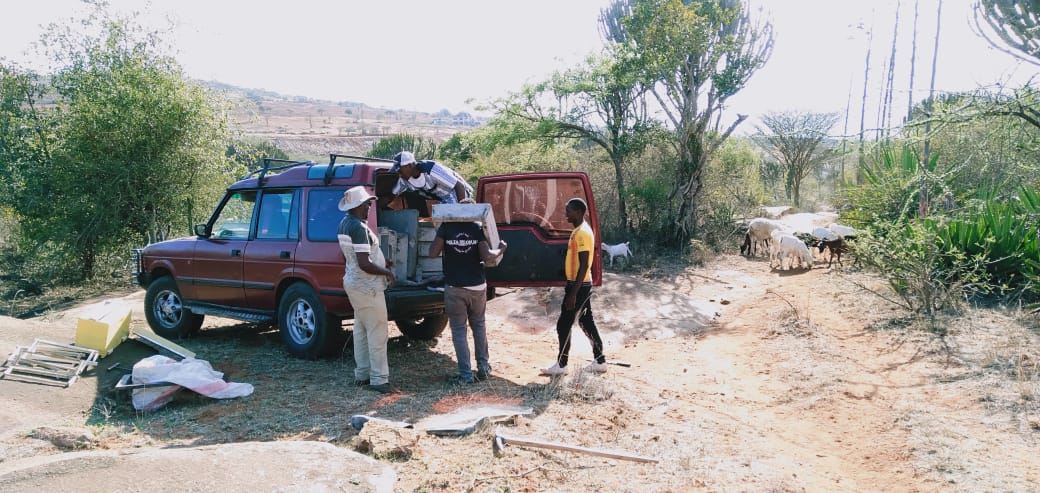
Beekeeping requires no tillage, no irrigation, no planting season, and no soil fertility. Bees fly up to 3 kilometres from the hive to forage, meaning they draw from a vast natural landscape you don’t have to tend or pay for. Acacia scrubland, indigenous forest edges, semi-arid bush — all of these, often considered liabilities for conventional farming, are premium bee habitats.
A well-managed hive can yield approximately 20 kg of honey per harvest cycle, with strong colonies in good forage areas producing up to 30–40 kg per harvest during peak seasons between December and March. With two or more harvests possible per year, the numbers accumulate meaningfully. And as you will see in the next section, the type of hive you choose makes an enormous difference to those yields.
A modest commercial setup of 20 hives operating at 80% productivity generates roughly 320 kg of honey per year. At current semi-refined bulk prices of around KSh 500 per kg, that translates to KSh 160,000 annually from a footprint that takes up less space than a single maize plot — and requires a fraction of the labour.
Scale that to 100 hives, improve processing and packaging to access premium retail or export channels, and you are looking at an entirely different income conversation.
The Hive Matters: Why Mister Bee Uses Concrete, Not Wood
Most people picture a wooden box when they think of a beehive. In Kenya and across Africa, the traditional wooden hive has been the default for decades. But there is a growing body of evidence — and Mister Bee’s own five years of research and field testing — that wooden hives are one of the biggest hidden costs and productivity drains in commercial beekeeping.
Mister Bee’s answer to this problem is the Mister Bee Concrete Hive: a patented, award-winning innovation that was developed specifically to solve the real-world challenges facing beekeepers across Africa. It is not a modification of an existing design. It is a ground-up reinvention — and the results speak for themselves.
Here is what makes the concrete hive the superior choice for any serious landowner or investor:
Up to 40% More Honey
The single most important metric for any investor is yield. Concrete’s natural thermal properties maintain a stable internal temperature inside the hive regardless of external conditions. Wooden hives, by contrast, become dangerously hot in warm weather and cold during cool nights — forcing bees to expend enormous energy on temperature regulation rather than honey production. The Mister Bee Concrete Hive eliminates that energy drain entirely. Bees living in a concrete hive produce up to 40% more honey than those in wooden hives — a figure that translates directly into higher revenue from the same number of hives and the same land.
100% Honey Badger-Proof
Honey badgers are one of the leading causes of hive destruction across Kenya and sub-Saharan Africa. These animals are among the most persistent and powerful small predators on the continent, capable of tearing through even reinforced wooden hive boxes. A destroyed hive means lost bees, lost comb, lost honey, and months of recovery time. The Mister Bee Concrete Hive is the only hive on the market that is completely honey badger-proof. Its solid concrete construction is physically impenetrable — making it ideal for placement in remote and wild locations where honey badger activity is common.
Theft-Resistant by Design
Beehive and honey theft is a pervasive problem across rural Kenya, often deterring investment in productive sites that are distant from the owner. The Mister Bee Concrete Hive addresses this directly: each unit weighs approximately 100 kilograms and is fitted with a lockable design. The weight alone makes opportunistic theft virtually impossible. For a landowner or investor managing hives remotely — which is the very nature of passive income — this security is not a luxury. It is a prerequisite.
Fire-Treatable for Pest Control
Pests like wax moths and Varroa mites are responsible for devastating hive losses across Kenya — up to 35% of hives in some counties are already infested and condemned. The standard treatment for these pests is fire treatment: applying methylated spirit and lighting a controlled flame to burn off all pests within the hive. This is impossible with wooden hives, which would simply be destroyed. The Mister Bee Concrete Hive is fully fire-treatable — the process eliminates all pests without damaging the hive, and the hive can be recolonised immediately afterward. This is a genuine operational advantage that directly protects your investment.
Built to Last 100 Years
Wooden hives deteriorate within 4 to 5 years due to weather exposure, termite activity, and rot — after which they must be replaced entirely. Over a 20-year period, a single hive position occupied by wooden hives could require three to four replacements, each at full cost. The Mister Bee Concrete Hive is engineered to last over 100 years. You buy once. You harvest honey for generations. Over a century, that represents a saving of over $1,800 per hive compared to repeated wooden hive replacements. For a landowner thinking about long-term asset value, this is a meaningful distinction.
Environmentally Responsible — and Rewarded for It
Every mature tree yields only six wooden hives. Given that wooden hives need replacement every few years, maintaining a single hive position over 100 years can result in the felling of up to 25 mature trees. The Mister Bee Concrete Hive effectively saves 5 trees per hive over its lifetime — equivalent to a carbon offset of 10.5 tonnes of CO₂ per hive. This environmental credential is not just ethical positioning. It is a competitive advantage: Mister Bee was selected among the top 20 climate-smart enterprises by the Kenya Climate Innovation Centre (KCIC) from over 2,200 applicants — a recognition that opens doors to green financing, carbon credit frameworks, and ESG-aligned investor interest.
Designed for Remote, Passive Operation
Every feature of the Mister Bee Concrete Hive — the weight, the lock, the concrete structure, the pest resistance, the thermal stability — points toward a single operational reality: these hives can be installed in remote locations and left to work. You do not need to be present. You do not need to worry about badgers, thieves, weather, or wax moths gutting your colonies between visits. That is what makes the concrete hive the natural infrastructure of a passive income apiary. It is not just a hive. It is a low-maintenance, high-durability income-generating asset.
When Mister Bee installs an apiary on your land, we install concrete hives — because that is the standard that serious commercial beekeeping in Kenya demands.

The Mister Bee Model: You Own the Land. We Run the Apiary.
Most landowners are not beekeepers. And they shouldn’t need to be.
Mister Bee exists precisely to bridge that gap. Our model is designed for landowners and investors who want to monetise their land through beekeeping without taking on the operational burden of managing colonies themselves. We bring the expertise, the equipment, the hive management protocols, and the market access. You bring the land — and earn a share of the revenue.
Here’s what that partnership looks like in practice:
Site Assessment and Setup. Our technical team evaluates your land for forage potential, hive placement, shade, water sources, and security. We then install Mister Bee Concrete Hives — our patented, award-winning innovation — engineered for the specific conditions of Kenyan landscapes and built to last over 100 years.
Colony Management. Our certified apiarists manage the day-to-day operations: colony health checks, swarm management, pest and disease monitoring, and seasonal feeding where necessary. You are not expected to suit up or pick up a smoker.
Harvesting and Processing. We handle honey extraction, filtering, and quality grading. Where applicable, we produce value-added products including beeswax, propolis, and comb honey, all of which command premium prices.
Revenue Sharing. Landowners receive a structured share of net revenues on a schedule agreed at the outset. As the apiary scales and productivity improves, your returns grow with it.
Transparency and Reporting. We provide regular apiary performance updates — hive counts, occupancy rates, harvest volumes, and revenue statements — so you always know exactly what your land is producing.
This is genuinely passive income. The bees do the work. Our team manages the operation. Your land generates revenue.
Multiple Revenue Streams from a Single Apiary
One of the strategic advantages of beekeeping that many landowners overlook is the diversity of products a well-managed apiary can generate beyond honey alone.
Honey is the primary product, but it exists across multiple market tiers: crude honey for local brewing, semi-refined honey for bulk buyers, refined honey for retail, and premium chunk or raw honey for health-conscious urban consumers and export markets.
Beeswax is consistently in demand from candle manufacturers, cosmetic producers, and pharmaceutical companies. Prices per kilogram are strong and supply remains tight across East Africa.
Propolis, a resinous compound bees use to seal their hives, has surged in demand globally due to its documented antimicrobial and antiviral properties. Premium-grade propolis commands extraordinary prices in health supplement markets.
Pollination services represent an emerging revenue stream in Kenya, particularly for orchardists and commercial vegetable growers who are increasingly aware of the documented yield improvements that managed bee colonies deliver. Coffee, avocado, macadamia, and mango farmers are potential clients.
Carbon credits and biodiversity financing are nascent but growing opportunities. Landowners who maintain beehives alongside native vegetation may qualify for emerging environmental financing schemes as Kenya’s green economy matures.
A well-structured Mister Bee partnership is designed to capture value across as many of these streams as your land and market access support.
The Risk Profile: Lower Than You Might Expect
Every investment carries risk, and responsible landowners ask about it. In beekeeping, the main risks are colony loss (from disease, pesticide exposure, or poor management), climate variability, and market price fluctuations.
Here is how those risks stack up against other land uses:
Unlike crop farming, a poor beekeeping season does not require you to restart from scratch with fresh seed, soil preparation, and irrigation. Surviving colonies can be built back quickly. Modern hive designs and monitoring protocols have dramatically improved colony survival rates. Unlike livestock, bees do not require daily feeding, veterinary expenses, or labour-intensive herding.
Price volatility in the honey market exists, but the trend line is decisively upward. Africa’s honey market is projected to grow at a CAGR of 2.1% in value through 2035, with premium organic and traceable honeys commanding even stronger premiums. A Mister Bee apiary is positioned to access those premium tiers through branding, packaging, and market relationships that a solo smallholder beekeeper cannot easily reach.
The key risk mitigant is management quality and hive infrastructure. Research from Kenya’s own academic institutions consistently shows that modern hive management significantly outperforms traditional methods — not just in yield, but in colony stability and revenue predictability. And the Mister Bee Concrete Hive addresses the most common operational risks at the infrastructure level: honey badger attacks, theft, pest infestations, and weather exposure are all dramatically reduced by the concrete hive’s design. Professional management combined with the right hive technology is the dual risk reduction strategy that Mister Bee deploys on every partner site.
Who Is This Right For?
Mister Bee’s land partnership model is designed for a specific kind of investor. You might be:
A landowner with rural or peri-urban land that is currently unused or underperforming — perhaps farmed seasonally with marginal returns, or leased informally at below-market rates.
An urban professional or diaspora investor who owns ancestral land but lacks the time, knowledge, or proximity to manage agricultural activities personally.
A real estate developer or land bank investor looking to generate interim income from land while longer-term development plans mature.
A conservation-minded landowner who wants to protect natural vegetation on your property while generating revenue — beekeeping actively incentivises the preservation of flowering trees and wild flora.
A farmer seeking diversification who already runs crops or livestock and wants to add a low-competition, low-conflict income stream that enhances rather than disrupts your existing activities.
If you fall into any of these categories and you have land in a region with adequate natural forage, we want to speak with you.
The Opportunity Cost of Waiting
Kenya is at an inflection point in apiculture. Government policy is increasingly supportive. The National Beekeeping Institute continues to expand training programmes. International development partners including WFP, ICIPE, UNDP, and SNV are investing in supply chain development and market linkages. Agricultural finance institutions are beginning to recognise beekeeping as a bankable enterprise.
The landowners and investors who move early — who put productive colonies on their land now — will benefit not just from the first-mover advantage in honey sales, but from the appreciation in apiary infrastructure value, the establishment of productive colonies, and the market relationships that take years to build.
Three-quarters of Kenya’s honey production potential is sitting in the ground, waiting for someone to act. That land may already be yours.
Start the Conversation
At Mister Bee, we assess every potential site individually. We understand that no two parcels of land are the same, and we design apiary partnerships that reflect the specific characteristics and commercial potential of your property.
The process begins with a site consultation — an honest, no-obligation assessment of what your land can produce and what a Mister Bee partnership would look like in your specific context.
If your land is sitting idle, it is not resting. It is losing value and opportunity every day.
Let’s change that.
Contact Mister Bee today to schedule your land assessment.
Mister Bee is a Kenyan apiculture enterprise specialising in commercial honey production, apiary management, and land-based beekeeping partnerships. We work with landowners across Kenya to convert underutilised land into productive, revenue-generating apiaries using modern hive technology and professional colony management.
Sources: Kenya Apiculture Platform; International Journal of Research and Innovation in Social Science (Kitui County Beekeeping Study, 2025); Frontiers in Sustainable Food Systems (Baringo County Beekeeping Study, 2026); IndexBox Africa Honey Market Report 2024–2035; Mordor Intelligence Global Honey Market Report 2025; Fortune Business Insights Honey Market Report 2025; World Food Programme Kenya Beekeeping Programme; FAO Apiculture Statistics.